

EMDR Therapy

Are you struggling with trauma, anxiety, or disturbing memories that traditional therapy hasn't resolved? EMDR (Eye Movement Desensitization and Reprocessing) is a powerful, evidence-based therapy that helps your brain reprocess painful experiences—often producing results in weeks rather than months.
At St. Charles Advanced Therapy™, you can experience a profound shift in how your brain processes the past with our EMDR therapy—a evidence-based path designed to desensitize traumatic triggers and restore your natural capacity for resilience and peace.
We integrate EMDR with Polyvagal Theory to ensure your nervous system stays grounded and safe throughout the healing process.
In a documentary with Oprah Winfrey, Prince Harry is seen undergoing a form of therapy known as EMDR (eye movement de-sensitization and reprocessing) to treat unresolved anxiety stemming from the death of his mother, Diana, Princess of Wales, when he was 12.
EMDR was developed in the 1980s by a U.S. psychologist, Francine Shapiro. While walking in a park, Shapiro suspected that her eye movements were lessening the distress of her own traumatic memories. She tested the approach on others and over time built up a standardized psychological therapy for treating people with traumatic memories.
See EMDR in Action
Watch this brief introduction to EMDR therapy to understand how it works and what to expect in your sessions.

Meet Melissa Hill, LCSW, our EMDR specialist
The therapy is recommended for post-traumatic stress disorder (PTSD), and it is used for a variety of problems brought on by past trauma. Many patients will have a deeply disturbing event in their past that resurfaces through intrusive thoughts, nightmares or flashbacks, causing fear, anxiety and sometimes an urge to avoid situations that trigger the memory.
People who have EMDR therapy take part in several (6 to 8) sessions during which they are asked to focus on the experiences that trouble them and the sensations they cause. In Prince Harry’s sessions with the psychotherapist Sanja Oakley, Harry describes flying into London as being a “trigger” for his own anxieties and sense of feeling “hunted”.
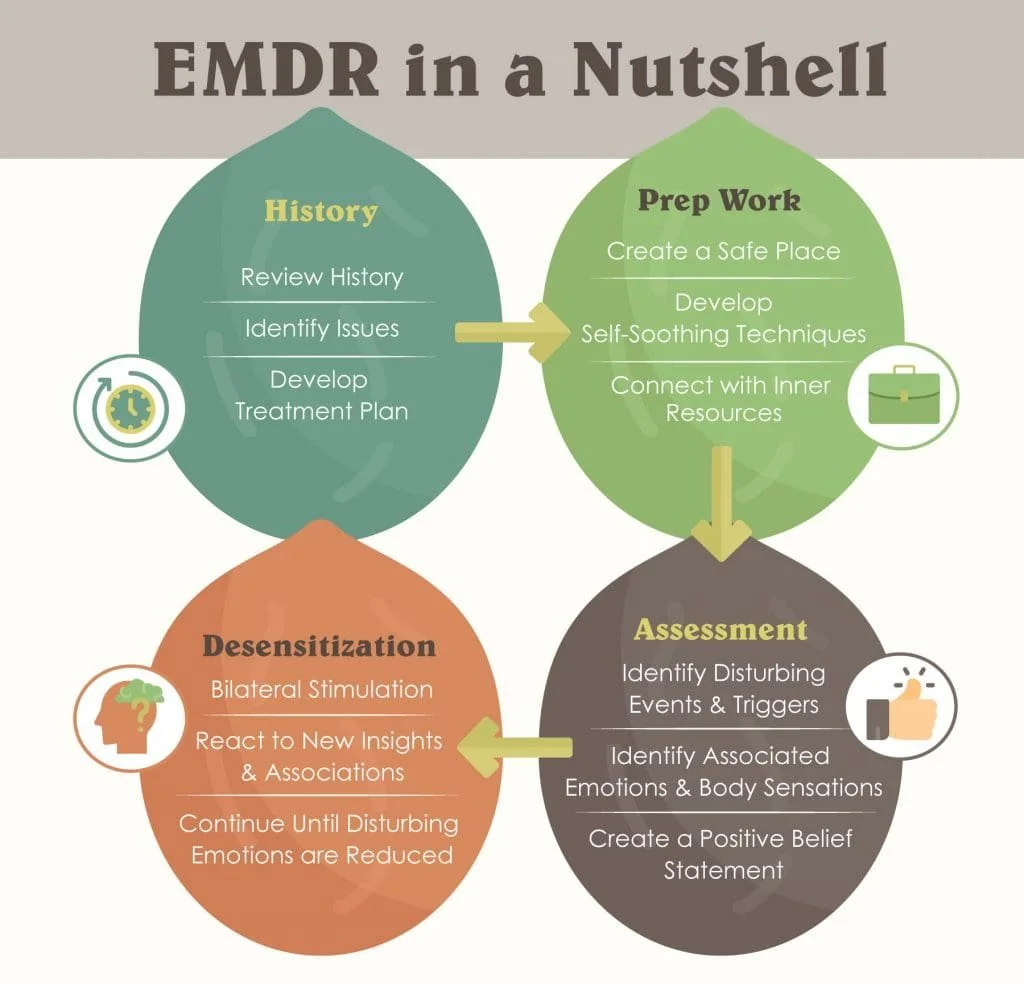
While focused on a particular experience or event, people undergoing EMDR receive what is called “bilateral stimulation”. This often means following the therapist’s finger as it moves left and right, or playing sounds into one ear and then the other. In Harry’s case, he crossed his arms and tapped his chest alternately on the left and right side to provide the stimulation. There is no hypnosis involved: people are fully conscious during the therapy.

The aim of EMDR is to reduce the distressing emotions that particular memories and triggering situations bring on. How it works is unclear, but the thinking is that traumatic events are not stored in the same way as normal, healthy memories, and so they can resurface and intrude. In EMDR therapy, people are forced to divide their attention, focusing on the bilateral stimulation at the same time as they are concentrating on the traumatic event. The therapy doesn’t help people to forget bad memories, but it is said to dampen down the distress they cause by allowing the brain to process and store the memory normally.
What Conditions Does EMDR Treat?
Post-traumatic stress disorder (PTSD)
Anxiety and panic attacks
Depression
Phobias
Complex trauma
Grief and loss
Performance anxiety
Disturbing memories
How Does EMDR Work?
At St. Charles Advanced Therapy™, we integrate EMDR with Polyvagal Theory to ensure your nervous system stays grounded and safe throughout the healing process. EMDR therapy uses bilateral stimulation—such as eye movements, tapping, or sounds—while you recall traumatic memories. This process helps your brain reprocess these memories, reducing their emotional intensity and allowing natural healing.
Who Can Benefit from EMDR Therapy?
You might benefit from EMDR if you:
Have tried traditional talk therapy without complete resolution
Experience intrusive thoughts, flashbacks, or nightmares about past events
Feel triggered by situations that remind you of painful experiences
Struggle with anxiety, panic attacks, or hypervigilance
Have difficulty trusting others or forming close relationships due to past trauma
Experience negative beliefs about yourself that stem from past experiences
Want faster results than traditional therapy typically provides
Find it difficult to verbally discuss traumatic experiences
EMDR is effective for:
Adults dealing with single-incident trauma (accidents, assault, loss)
Individuals with complex trauma or childhood trauma
First responders experiencing critical incident stress
Anyone experiencing the lasting effects of disturbing life events
EMDR vs. Traditional Talk Therapy
EMDR offers several advantages:
Faster results - Many clients achieve significant improvement in 6-12 sessions vs. months or years of talk therapy
Less verbal processing - You don't need to describe trauma in extensive detail
Targets the root cause - Reprocesses traumatic memories stored in the brain and nervous system
Evidence-based - Decades of research supporting its effectiveness for trauma and PTSD
Whole-brain healing - Engages both hemispheres through bilateral stimulation
EMDR can be used as a standalone treatment or integrated with traditional therapy for comprehensive healing.
What to Expect in EMDR Therapy Sessions
Typical treatment: 6-12 sessions
Session length: 60-90 minutes
No homework required
You remain fully conscious
Safe, structured 8-phase protocol
Why Choose St. Charles Advanced Therapy™ for EMDR?
Trained EMDR Specialists - Our therapists have advanced training and certification in EMDR therapy, with 35+ years of combined clinical experience treating trauma.
Polyvagal-Informed Approach - We integrate EMDR with Polyvagal Theory to ensure your nervous system stays regulated, making the healing process safer and more effective.
Proven Results - We've helped hundreds of Kane County residents process trauma and reclaim their lives through this powerful therapy.
Insurance-Friendly - We accept Blue Cross Blue Shield, Aetna, Cigna, Health Alliance Plan, and UnitedHealthcare/Optum to make EMDR accessible.
Local & Trusted - Serving Geneva, Batavia, St. Charles, and the Fox Valley since 2019. We understand our community and are invested in your healing.
Flexible Options - Both in-person and secure virtual EMDR sessions available.
Frequently Asked Questions About EMDR
Is EMDR therapy effective? Yes. EMDR is recognized by the American Psychiatric Association, World Health Organization, and Department of Veterans Affairs as an effective treatment for trauma and PTSD. Research shows it can produce faster results than traditional talk therapy alone.
How many EMDR sessions will I need? Most clients see significant improvement within 6-12 sessions, though this varies based on individual needs and trauma complexity. Some single-incident traumas may resolve in as few as 3-6 sessions.
Does EMDR work for anxiety without trauma? Yes. While EMDR was developed for PTSD, it effectively treats various anxiety disorders, panic attacks, phobias, and disturbing memories even when there's no clear traumatic event.
Is EMDR covered by insurance? Yes. We accept BCBS, Aetna, Cigna, Health Alliance Plan, and UHC/Optum. EMDR is typically covered as a standard psychotherapy service. Contact us to verify your specific coverage.
What's the difference between EMDR and regular therapy? EMDR specifically targets traumatic memories using bilateral stimulation, often achieving results faster than traditional talk therapy. It's particularly effective for clients who find it difficult to discuss trauma verbally or who have tried talk therapy without full resolution.
Is EMDR safe? Yes. EMDR is an evidence-based therapy with decades of research supporting its safety and effectiveness. At St. Charles Advanced Therapy, we integrate EMDR with Polyvagal Theory to ensure your nervous system remains regulated throughout treatment.
Will I have to talk about my trauma in detail? Not necessarily. One of EMDR's benefits is that you don't need to describe traumatic events in extensive detail. The bilateral stimulation allows your brain to process memories without requiring lengthy verbal descriptions.
Do I need to be diagnosed with PTSD to benefit from EMDR? No. EMDR helps with many conditions including anxiety, depression, phobias, grief, performance anxiety, and disturbing memories—even without a PTSD diagnosis.
ALL INQUIRIES ARE CONFIDENTIAL.
Not ready to make an appointment? See our Rates & Insurance and what our clients say about us.